How To Download Option Chain Data From Yahoo Finance UPDATED
How To Download Option Chain Data From Yahoo Finance

How can nosotros download fundamentals data with Python?
In this post we will explore how to download fundamentals information with Python. We'll be extracting fundamentals data from Yahoo Finance using the yahoo_fin parcel. For more on yahoo_fin, including installation instructions, cheque out its full documentation hither or my YouTube video tutorials here.
Getting started
Now, let's import the stock_info module from yahoo_fin. This will provide us with the functionality nosotros need to scrape fundamentals data from Yahoo Finance. Nosotros'll also import the pandas package every bit nosotros'll be using that later to piece of work with data frames.
import yahoo_fin.stock_info as si import pandas as pd
Next, we'll dive into getting mutual company metrics, starting with P/E ratios.
How to get P/Eastward (Price-to-Earnings) Ratios
At that place's a couple means to get the current P/E ratio for a company. First, we tin can use the get_quote_table method, which volition excerpt the data found on the summary page of a stock (come across here).
quote = si.get_quote_table("aapl") 
Adjacent, let's pull the P/Due east ratio from the dictionary that is returned.
quote["PE Ratio (TTM)"] # 22.71
A company's P/Eastward ratio can also be extracted from the get_stats_valuation method. Running this method returns a data frame of the "Valuation Measures" on the statistics tab for a stock.
val = si.get_stats_valuation("aapl") val = val.iloc[:,:ii] val.columns = ["Aspect", "Contempo"] Next, allow'southward extract the P/E ratio.
float(val[val.Aspect.str.contains("Trailing P/E")].iloc[0,1]) How to get P/S (Price-to-Sales) Ratios
Another pop metric is the P/South ratio. We can go the P/Due south ratio, along with several other other metrics, using the same get_stats_valuation method. Let's use the object we pulled above, currently stored as val.
Then, we tin get the Price/Sales ratio like below.
float(val[val.Attribute.str.contains("Price/Sales")].iloc[0,ane]) Getting fundamentals stats for many stocks at one time
Now, let's get the Cost-to-Earnings and Price-to-Sales ratios for each stock in the Dow. We could also do this for a custom list of tickers equally well.
# go list of Dow tickers dow_list = si.tickers_dow() # Go data in the electric current cavalcade for each stock's valuation table dow_stats = {} for ticker in dow_list: temp = si.get_stats_valuation(ticker) temp = temp.iloc[:,:two] temp.columns = ["Aspect", "Recent"] dow_stats[ticker] = temp # combine all the stats valuation tables into a single data frame combined_stats = pd.concat(dow_stats) combined_stats = combined_stats.reset_index() del combined_stats["level_1"] # update cavalcade names combined_stats.columns = ["Ticker", "Attribute", "Recent"] Price-to-Earnings ratio for each Dow stock
The P/E ratio for each stock can be obtained in a single line:
# get P/E ratio for each stock combined_stats[combined_stats.Aspect.str.contains("Trailing P/E") Getting the Toll-to-Sales ratio for each Dow stock
Later the above code, we tin can get the Price / Sales ratios for each stock like beneath.
# go P/Due south ratio for each stock combined_stats[combined_stats.Attribute.str.contains("Cost/Sales") How to get Price / Book ratio
Similarly, we can get the Cost-to-Book ratio for every stock in our listing beneath.
# go Cost-to-Book ratio for each stock combined_stats[combined_stats.Aspect.str.contains("Toll/Book") How to get PEG ratio
Adjacent, let's get the PEG (Price / Earnings-to-Growth ratio).
# get PEG ratio for each stock combined_stats[combined_stats.Attribute.str.contains("PEG") How to get forrard P/E ratios
We can get forward P/E ratios like this:
# go forrard P/E ratio for each stock combined_stats[combined_stats.Attribute.str.contains("Forrad P/E")] Getting additional stats from multiple stocks
In addition to the "Valuation Measures" tabular array on the stats tab, we can likewise scrape the remaining information points on the webpage using the get_stats method. Calling this method lets usa excerpt metrics like Return on Equity (ROE), Return on Assets, turn a profit margin, etc. Click here to encounter the webpage for Apple.
Similar to above, we can go this information for each stock in the Dow.
dow_extra_stats = {} for ticker in tqdm(dow_list): dow_extra_stats[ticker] = si.get_stats(ticker) combined_extra_stats = pd.concat(dow_extra_stats) combined_extra_stats = combined_extra_stats.reset_index() del combined_extra_stats["level_1"] combined_extra_stats.columns = ["ticker", "Attribute", "Value"] How to get Render on Equity (ROE)
Using the effect data frame, combined_extra_stats, let's go Return on Equity for each stock in our list.
combined_extra_stats[combined_extra_stats.Attribute.str.contains("Return on Equity")] How to go Return on Assets
A unproblematic tweak gives u.s. Return on Assets for each stock.
combined_extra_stats[combined_extra_stats.Attribute.str.contains("Return on Avails")] How to get profit margin
To become profit margin, we but need to suit our filter like below.
combined_extra_stats[combined_extra_stats.Attribute.str.contains("Profit Margin")] How to go remainder sheets
We can extract residue sheets from Yahoo Finance using the get_balance_sheet method. Using the data frame that is returned, we tin can become several attributes about the stock'southward financials, including full cash on manus, avails, liabilities, stockholders' disinterestedness, etc.
sheet = si.get_balance_sheet("aapl") How to become total greenbacks on hand
We tin see the "Total Greenbacks" row in the balance sheet by filtering for "cash". This will give u.s.a. the full cash value for the last several years.
sheet.loc["cash"]
How to get stockholders' equity
Next, we can as well get Total Stockholders' Equity.
canvass.loc["totalStockholderEquity"]
How to go a company's full assets
Now, let's get Total Avails.
sheet.loc["totalAssets"]
How to get residue sheets for many stocks at one time
Like with the company statistics tables we pulled earlier, we tin also download the balance canvas for all the stocks in the Dow (or once again, a custom listing of your choice).
balance_sheets = {} for ticker in dow_list: balance_sheets[ticker] = si.get_balance_sheet(ticker) From here, we could then look at values from the rest sheets beyond multiple companies at in one case. For example, the lawmaking beneath combines the balance sheets from each stock in the Dow. Since each private residuum sheet may have unlike column headers (from different dates), we'll just go the well-nigh recent column of data from the balance sheet for each stock.
recent_sheets = {ticker : sheet.iloc[:,:1] for ticker,sheet in balance_sheets.items()} for ticker in recent_sheets.keys(): recent_sheets[ticker].columns = ["Recent"] # combine all balance sheets together combined_sheets = pd.concat(recent_sheets) # reset index to pull in ticker combined_sheets = combined_sheets.reset_index() # update column names combined_sheets.columns = ["Ticker", "Breakdown", "Recent"] 
Now we take a data frame containing the balance sail information for each stock in our list. For example, we tin can look at the Total Assets for each Dow stock like this:
combined_sheets[combined_sheets.Breakdown == "totalAssets"]
How to get income statements
Next, allow'south examine income statements. Income statements tin can exist downloaded from Yahoo Finance using the get_income_statement method. See an case income argument here.
si.get_income_statement("aapl") Using the income statement, we can examine specific values, such equally total revenue, gross profit, total expenses, etc.
Looking at a company'southward total revenue
To go the total acquirement, we simply need to apply a filter like previously.
income.loc["totalRevenue"]
Getting a company's gross profit
Similarly, we can go the gross profit:
income.loc["grossProfit"]
Getting the income statement from each Dow stock
Next, let's pull the income argument for each Dow stock.
income_statements = {} for ticker in dow_list: income_statements[ticker] = si.get_income_statement(ticker) At present, we can expect at metrics in the income statement across multiple companies at once. First, we but need to combine the income statements together, like to how we combined the residue sheets higher up.
recent_income_statements = {ticker : sheet.iloc[:,:1] for ticker,sheet in income_statements.items()} for ticker in recent_income_statements.keys(): recent_income_statements[ticker].columns = ["Recent"] combined_income = pd.concat(recent_income_statements) combined_income = combined_income.reset_index() combined_income.columns = ["Ticker", "Breakup", "Recent"] 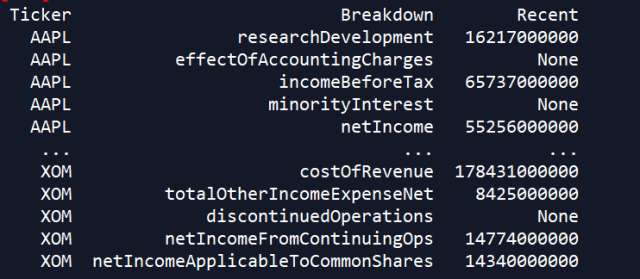
Now that nosotros have a combined view of the income statements across stocks, nosotros tin can examine specific values in the income statements, such as Full Revenue, for example.
combined_income[combined_income.Breakdown == "totalRevenue"]
How to extract cash flow statements
In this department, we'll extract cash flow statements. We can do that using the get_cash_flow method.
flow = si.get_cash_flow("aapl") Here's the get-go few rows of the cash flow statement:

At present let'due south get the greenbacks flow statements of each Dow stock.
cash_flows = {} for ticker in dow_list: cash_flows[ticker] = si.get_cash_flow(ticker) Once again, we combine the datasets to a higher place, using similar code as before.
recent_cash_flows = {ticker : period.iloc[:,:1] for ticker,flow in cash_flows.items()} for ticker in recent_cash_flows.keys(): recent_cash_flows[ticker].columns = ["Contempo"] combined_cash_flows = pd.concat(recent_cash_flows) combined_cash_flows = combined_cash_flows.reset_index() combined_cash_flows.columns = ["Ticker", "Breakdown", "Recent"] Now, we can examine information in the cash flow statements across all the stocks in our listing.
Getting dividends paid across companies
I example to look at in a cash flow statement is the corporeality of dividends paid, which we can see across the companies in our list by using the filter below.
combined_cash_flows[combined_cash_flows.Breakdown == "dividendsPaid"]
Getting stock issuance information
Here'southward another example – this time, we'll expect at debt-related numbers across the greenbacks flow statements.
combined_cash_flows[combined_cash_flows.Breakdown == "issuanceOfStock"]
Conclusion
That'south it for this post! Larn more virtually web scraping by checking out this online course on Udemy that I co-created with 365 Data Science! You lot'll learn all most scraping data from different sources, downloading files programmatically, working with APIs, scraping JavaScript-rendered content, and more than! Cheque information technology out here!
DOWNLOAD HERE
Posted by: mayerlackou.blogspot.com

